Quick Insights:
- Problem: I wanted a focused place to track what I read, keep short notes and quickly recall why a book mattered, along with a few smart suggestions for what to read next.
- Solution: Built Shelfwise, a small personal reading companion where each book has notes, a BERT based notes summary and inline recommendations driven by cosine similarity over book embeddings.
- Result: The app turns scattered reading notes into a structured library. A single GraphQL query powers the main view with book details, summaries and recommendations, which keeps the React code simple and avoids multiple REST calls.
Introduction
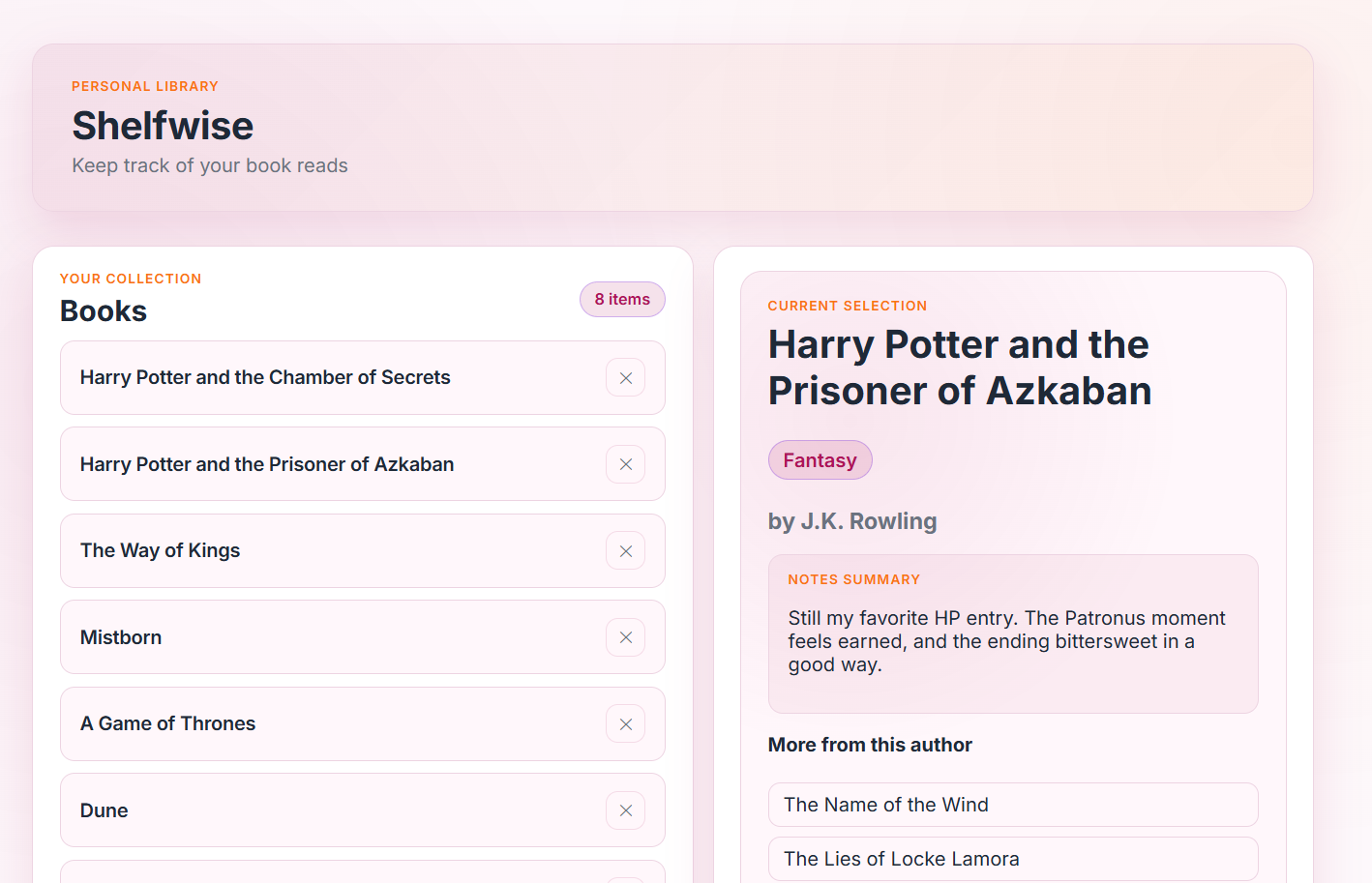
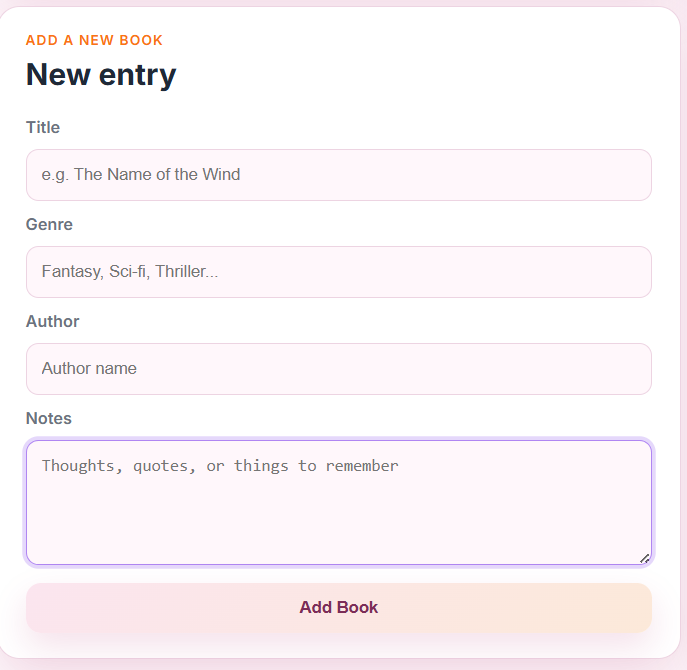
Shelfwise is a personal library application that helps me track my reading and capture lightweight reflections. Each entry includes a title, genre, author and notes. The app highlights a single current selection and presents the notes summary and suggested next reads side by side.
The project is built as a small full stack system: a React.js frontend with Apollo Client talks to a Node and Express backend that exposes a GraphQL API. Data is stored in memory for easy demo and testing, which keeps the focus on schema design, resolver logic and UI flow rather than infrastructure.
Demonstration
Architecture and GraphQL design
Shelfwise uses GraphQL as the main boundary between the React frontend and the Node backend. The main screen needs a mix of base data and derived data: raw notes, a BERT based summary and a list of similar books. GraphQL lets the UI fetch all of that in a single, strongly typed query.
Why GraphQL fits this project
- The main view can fetch all data for a selected book in one round trip: title, genre, author, notesSummary and recommendations.
- Derived fields live behind resolvers. The backend owns how summaries and recommendations are computed, while the client only asks for the fields it needs.
- The schema doubles as a contract: adding future fields like rating or reading status is a small, discoverable change.
Summarisation and recommendations
- Notes summarisation with BERT: when a user saves notes, the backend encodes the text using a sentence BERT model and scores sentences by importance. The top sentences are stitched into a short notesSummary that fits naturally into the UI.
- Recommendations via cosine similarity: for each book, an embedding is computed from its title and a short description using the same BERT encoder. These embeddings are compared against a small open dataset of books (a filtered slice of the Goodbooks-10k dataset), and the closest matches by cosine similarity are returned as recommendations, excluding the current title.
Representative GraphQL schema snippet
// backend/schema.js (excerpt)

const BookType = new GraphQLObjectType({
  name: "Book",
  fields: () => ({
    id: { type: new GraphQLNonNull(GraphQLID) },
    title: { type: new GraphQLNonNull(GraphQLString) },
    genre: { type: new GraphQLNonNull(GraphQLString) },
    notes: { type: GraphQLString },

    notesSummary: {
      type: GraphQLString,
      resolve: (book, args, ctx) =>
        ctx.services.summarizer.summarizeWithBert(book.notes),
    },

    recommendations: {
      type: new GraphQLList(BookType),
      resolve: (book, args, ctx) =>
        ctx.services.recommender.similarBooksByCosine(book),
    },
  }),
});

// Query { books, book(id: ID!) } and Mutation { addBook(...) } sit on top
// of this type and are used by the React UI via Apollo Client.
The Book type exposes both stored fields and derived fields. React components can request title, genre, notesSummary and recommendations in one query, while the backend hides the BERT based summarisation and cosine similarity logic inside services.
Key outcomes and learnings
Shelfwise is a small but well rounded project that combines UI work, schema design and lightweight ML to improve the reading experience.
- Designed a GraphQL schema that keeps the React components simple by centralising summarisation and recommendation logic on the server.
- Built a responsive reading dashboard that makes it easy to add books, review notes and decide what to read next in one place.
- Structured the backend so that the in memory data store can later be swapped for a persistent database without changing the GraphQL contract.
- Used BERT embeddings and cosine similarity to add ML driven behaviour without complicating the frontend or the API surface.