Quick Insights:
- Problem: Homeowners and interior clients often rely on catalog photos and imagination to choose tiles. It is hard to visualize how a pattern will look in their own room and comparing options usually means multiple store visits and trial and error.
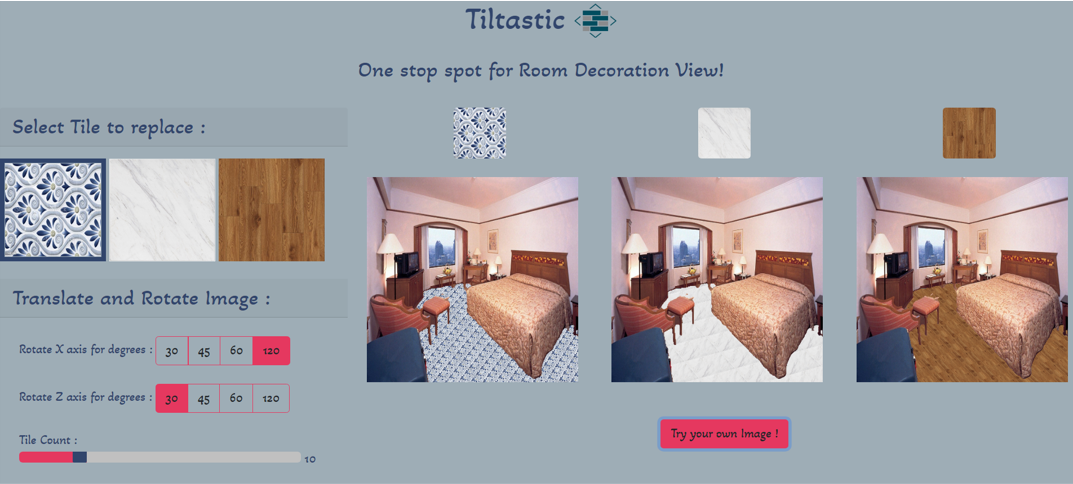
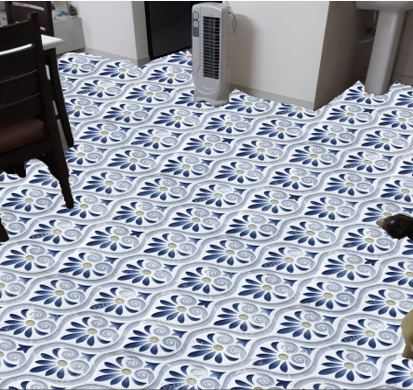
- Solution: Built Tiltastic, a web application that takes a room photo and a tile design as input, detects floors or walls using a Tensorflow based segmentation model and MiDaS depth maps, then overlays the new tiles with realistic perspective, lighting and tile count controls. The experience feels like trying different tiles directly on the user’s own space.
- Result: Achieved around 85 to 90 percent visually accurate floor and wall replacements on test images while keeping the workflow simple: upload, choose design, tweak angles and compare variations in a few seconds. The same pipeline can extend to paint colors, furniture and other interior elements.
Introduction
Tiltastic was developed during a machine learning internship at SoftmaxAI. The goal was to turn tile selection into a visual advisory experience that works on any standard room photo. Instead of asking users to imagine a final look from catalog images, Tiltastic generates a realistic composite of the chosen tiles directly on their own floor or wall.
The system uses a React based front end that talks to Flask APIs hosting trained Tensorflow and Keras models. A floor detection model segments the room, MiDaS based monocular depth estimation produces a depth map, and OpenCV pipelines handle corner detection, masks and pixel level replacement. Results are served back through AWS hosted infrastructure so the application can be accessed remotely.
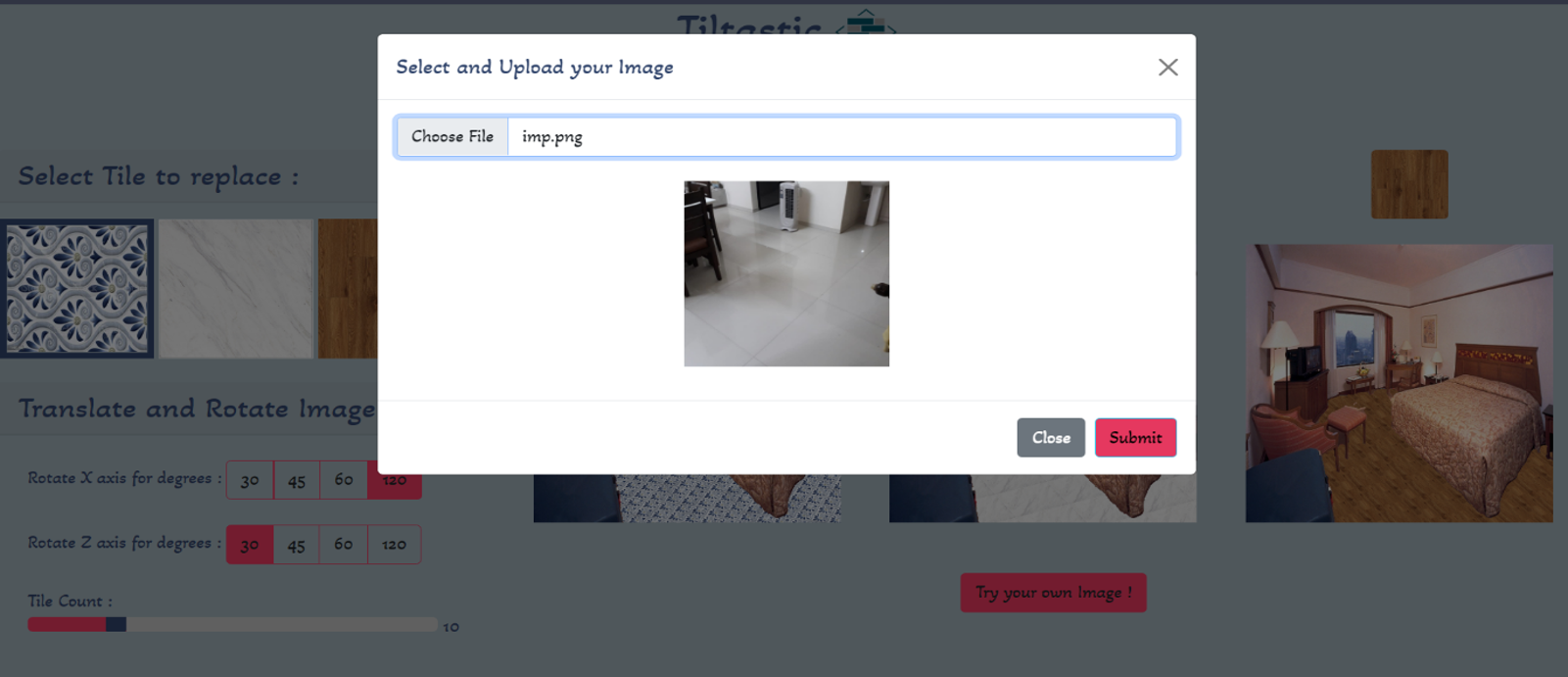
- Users upload a room image, choose from preset tile designs or custom textures and then adjust rotation along X and Z axes plus tile count for the final visualization.
- The backend keeps the segmented floor and depth information cached per session, reducing repeated visualization time from around 60 seconds to 30 seconds when trying multiple tile designs on the same image.
- The project followed an incremental model: starting from data collection and segmentation, then model training, then depth mapping, then tile replacement functions, and finally an integrated web experience deployed on AWS.
Flow Diagram

Demonstration
Key Outcomes and Learnings
Tiltastic combined computer vision, depth estimation and web development into a single, user facing product. It required designing a pipeline that is accurate enough for visual decision making while remaining responsive in a browser.
- Reduced manual trial and error by letting users experiment with multiple tile designs from home, replacing the need for repeated store visits and physical samples for many early decisions.
- Learned how to train and integrate segmentation and depth models with Flask APIs, including handling image preprocessing, model loading, error cases and response formatting.
- Implemented pixel level replacement and corner estimation using depth gradients, which improved alignment for oblique camera angles and non rectangular rooms.
- Applied an iterative development process: start with floor only, then add wall support, then optimize for repeated design changes on the same image.
- Demonstrated that a relatively compact model plus efficient preprocessing can provide visually convincing results at around 85 to 90 percent accuracy on realistic home interior photos.